
Step into an exhibition that asks what changes when we see ourselves not as separate from the living world, but as part of it.
Presented by CASA and Not The Owners
Curated by Gabriela Román González
Private Viewing | 7 Oct 6:00 PM
Exhibition | 8 - 30 October 2026
Exhibition opening times | 10:00 AM - 6:00 PM
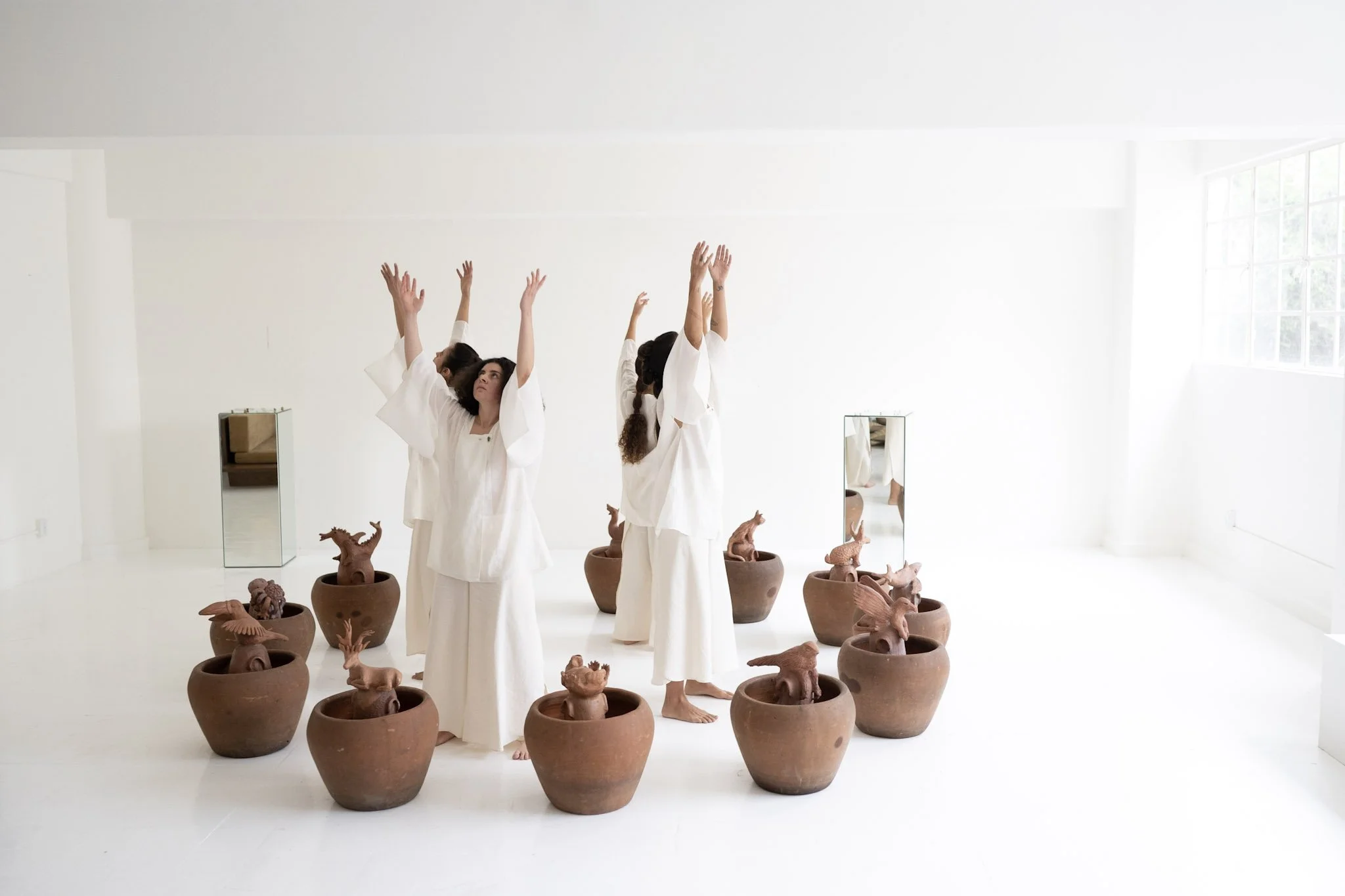
Bringing together the work of Aileen Gavonel, Lucia Pizzani, María Helena Toscano, Mena Guerrero and Sebastián Espejo, Keeping Things Whole explores artistic practices shaped through long-term relationships with landscapes, clay, plants, memory and living systems.
Across the exhibition, materials and natural processes are not simply subjects or resources, but active participants in the making of the work. Through sustained exchanges with different environments and forms of life, the artists explore what can emerge when we pay closer attention to the world around us and allow it, in turn, to shape how we make, perceive and relate.
Keeping Things Whole invites us to reconsider the boundaries between ourselves and our surroundings: to see human life as entangled with other forms of life, materials and temporalities, and to imagine another way of being alive together.
The exhibition takes its title from Mark Strand’s poem Keeping Things Whole, extending its reflection on presence and relation towards the continuous reciprocity between human and more-than-human life.
Part of Lines of Flight
This event is part of Acts of Looking, the final chapter of Lines of Flight, CASA’s year-round multi-arts programme curated by Gabriela Román González at Brixton House. Across exhibitions, residencies, dance, performance and celebration, Acts of Looking turns attention towards what is often overlooked, exploring how different ways of seeing might change the way we live.
Practical information
Free entry | RSVP required
Private View: 7 October, 6:00 PM
Exhibition: 8–30 October
Location: The Nook, Brixton House
About the artists, curator and partners
-
(Lima, Peru) is a visual artist whose practice explores the poetic and ritual dimensions of clay as a medium for listening, care, and resistance. Working across ceramics, installation and visual poetry, she investigates the relationships between material, territory and memory, imagining more sensitive and situated forms of coexistence. She holds a BA in Art from the Pontificia Universidad Católica del Perú and an MA in Ceramics & Glass from the Royal College of Art, London.
-
born in Caracas and based in London, Lucia Pizzani works across sculpture, ceramics, drawing and performance. Her practice explores the relationship between the body, materiality and the natural world, with a particular focus on histories of women and processes of metamorphosis. Her work is held in the collections of Tate, the UK Government Art Collection, Magasin III, ESCALA, and the Colección Patricia Phelps de Cisneros, among others.
-
(b. 1987, Colombia) is a Venezuelan-Colombian multidisciplinary artist based between London and Berlin. Her practice spans sound, sculpture, installation, performance, and mixed media, investigating ritual technologies, extractivism, migration, and ecological memory through decolonial methodologies.She holds an MA in Contemporary Art Practice from the Royal College of Art, London, and trained in modular synthesis for live performance at the Berlin School of Sound. Recent exhibitions include Peluche Express (Somers Gallery, London), Collectivism x Cellulite (The Bomb Factory, London).
-
(b.1996) is a Guatemalan transdisciplinary artist. Her practice aims at developing transdisciplinary projects based on investigation and experimentation related to her personal account and environment and relationships. She was a resident at Fondation Fiminco artist in residence program in 2024. In 2022, she earned Beca Flotador for emerging artists from Teorética, Costa Rica and the first prize for the Galería Abierta by El Centro Cultural Municipal in Guatemala City. As of September of 2026, she will begin her Master’s degree program at The Royal College of Art in London.
-
(b. 1990, Viña del Mar, Chile) currently lives and works in London. Espejo’s work centres on the practice of painting as a way of exploring and interpreting life, perception and knowledge. The transience and beauty of everyday life shape the narrative of his works, which follow everyday environments while intentionally lacking any single event. This translation of environmental experience into painting connects his work to the Chilean pictorial tradition of ‘descriptive realism,’ defined by its direct sensory capture and the act of describing as an openness to transient moments.
-
Her practice centred on contemporary and process-led art, and more porous models of exhibition-making across disciplines. Her experience spans major institutions, festivals, and independent platforms, including collaborations with Cittadellarte – Fondazione Pistoletto, Tate Modern, Galleria Continua, ZONAMACO, and Frieze London. She serves as Head of Exhibitions and Programmes at CASA, Trustee of LADA and founder of Not The Owners and Mentoras Creativas.
-
(NTO) is a platform operating at the intersection of curatorial practice, interdisciplinary collaboration, and research. It supports contemporary artistic practices that challenge conventions and expand how art is seen, shared, and understood. Through exhibitions and collaborative projects, it develops context-aware ways of working and creates space for perspectives and artistic processes often overlooked by the mainstream.